

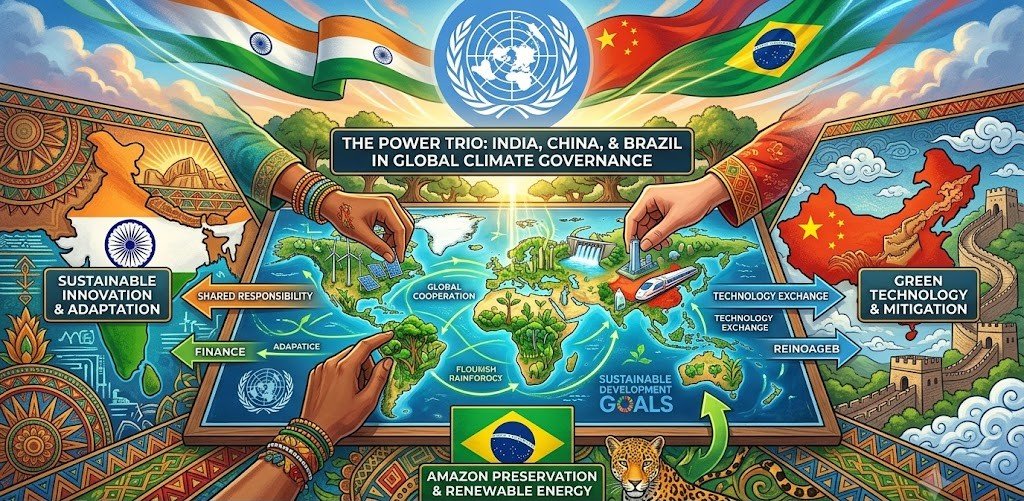
How Emerging Powers Are Reshaping Global Climate Governance
Climate change is no longer just an environmental issue. It is a matter of global politics, economic power, and national identity. As floods displace communities, droughts destroy crops, and heatwaves threaten public health, the world is realizing that solving the climate crisis requires diplomacy as much as it requires technology. For decades, wealthy Western nations dominated environmental decision-making. Today, that balance is shifting. India, China, and Brazil, three of the world's most populous and economically dynamic nations, are stepping into leadership roles in global climate governance, and understanding their strategies is key to understanding the future of climate diplomacy.
The industrial revolutions of Europe and North America were built on fossil fuels such as coal, oil, and gas, laying the foundation for today's climate crisis. Since the 19th century, developed nations have been the largest historical contributors to greenhouse gas emissions. This history matters. It shapes how emerging powers like India, China, and Brazil approach climate negotiations, often demanding fairness and shared responsibility rather than accepting blanket restrictions on their own growth.
Political theory offers a useful framework for understanding these dynamics. Through a realist lens, climate policy becomes a tool for gaining international influence. China's massive renewable energy investments and Brazil's Amazon conservation efforts both serve to strengthen global standing. Liberalism highlights cooperation, seen in institutions like the UNFCCC and agreements like the Paris Accord, where nations acknowledge that no single country can solve climate change alone. Meanwhile, constructivism emphasizes how values like climate justice shape national identity, allowing countries to project themselves as responsible global citizens rather than purely self-interested actors.
Climate diplomacy is not just about policy. It is about human psychology. Concepts like psychological distance, a term popularized by psychologist Daniel Kahneman, explain why people once viewed climate change as a distant problem. That is changing as droughts in India, floods in Brazil, and heatwaves in China make the crisis personal. Climate diplomacy also grapples with the classic collective action problem, where every nation benefits from emissions reductions but hesitates to bear the cost alone. Increasingly, environmental leadership has become a form of national pride and soft power.
China holds a unique position as both the world's largest polluter and its largest investor in clean energy. Massive investments in solar power, electric vehicles, and battery technology reflect Beijing's belief that future global power will be tied to green technology dominance, much like oil shaped 20th century geopolitics.
India's climate diplomacy centers on fairness, the right to development, and poverty alleviation. Through initiatives like the International Solar Alliance, India positions itself as a voice for the Global South, advocating for greater access to climate financing and technology transfer.
Brazil's climate identity is deeply tied to the Amazon rainforest, a critical global resource for biodiversity and climate regulation. Balancing economic development, agricultural exports, and rainforest protection remains one of Brazil's most complex environmental challenges, and a defining feature of its international identity.
Increasingly, India, China, and Brazil are coordinating through platforms like BRICS to push for climate finance reform, technology sharing, and greater representation in global institutions. This signals a shift toward a multipolar climate order, where power politics and environmental policy are deeply intertwined.
Climate diplomacy sits at the intersection of history, psychology, and international relations. As India, China, and Brazil continue to shape global environmental governance, their ability to balance domestic development with international responsibility will determine the success of global climate action for generations to come.


