

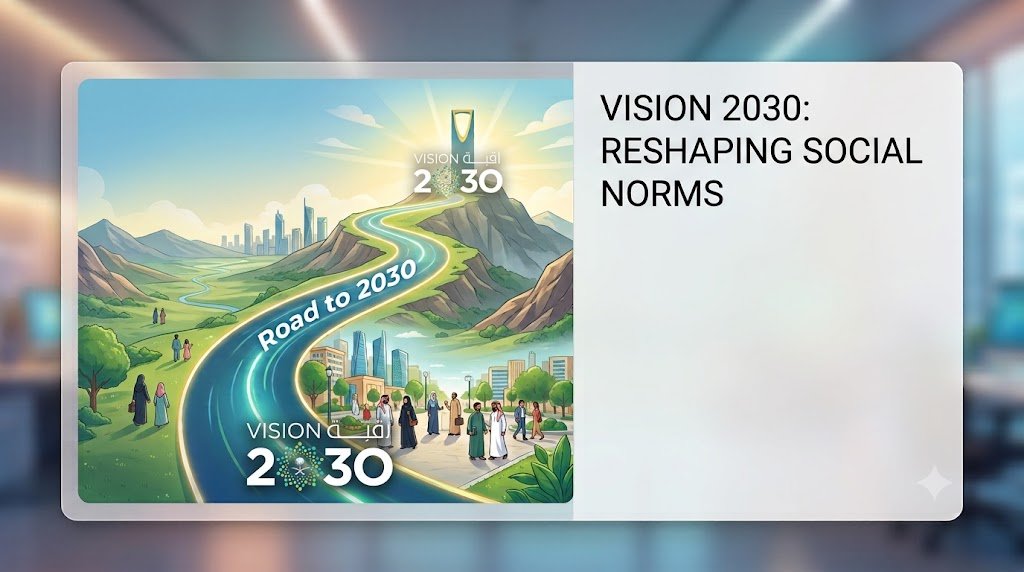
Breaking Free from the Oil Well
There's an old adage that necessity begets invention, and it holds true for Saudi Arabia's departure from an oil-dependent economy. For decades, oil defined the kingdom and filled its coffers. Vision 2030 changed that, laying out an ambitious plan to build a future not tethered to petroleum.
The effects aren't always obvious at first glance, but they matter well beyond Saudi borders. Regional tensions around the Strait of Hormuz, including the 2026 US-Iran conflict, have repeatedly threatened global energy supplies. While the rest of the region scrambled to respond, Saudi Arabia had already begun preparing for a different kind of future.
At the heart of Vision 2030 is a deliberate move away from oil dependency, and toward a new social contract, one built on state-approved moderate Islam, a more restrained clergy, and the energy of a young population. With more than 60% of Saudis under 30, the leadership has increasingly shaped policy around the priorities of its youth.
Few changes illustrate this shift better than the evolving role of women. In 2018, women gained the right to drive. Since then, guardianship restrictions have loosened, women have entered military service, and strict gender segregation in public spaces has relaxed.
Economic necessity underlies much of this. A nation aiming to lead in knowledge and technology needs its full population in the workforce, women included. The numbers reflect this: female labor force participation rose from about 20% in 2018 to over 35% by 2023. Alongside this, the government's sovereign wealth fund has poured investment into cinemas, theaters, and sports, aiming to create jobs, attract tourism, and keep spending within the kingdom.
Perhaps the most striking shift has been in religious messaging. Saudi Arabia was once known for exporting hardline conservative ideology, with imams given wide latitude over Friday sermons, a latitude that sometimes fueled hostility toward Israel and the West.
That has changed. The Ministry of Islamic Affairs now closely oversees sermon content, issuing weekly guidance emphasizing tolerance and productivity while explicitly rejecting groups like the Muslim Brotherhood. By controlling messaging at its source, the state has curbed one of the main channels through which extremist sentiment historically spread, and quiet cooperation with Israel has become an open secret.
In a region this volatile, these changes carry real weight. With tensions between the US and Iran repeatedly threatening the Strait of Hormuz, a corridor carrying roughly a fifth of the world's oil, economic diversification became less a preference than a necessity for Saudi Arabia's long-term stability.
What once looked like a standard development plan has proven remarkably far-reaching. While much of the Arab world remained focused on short-term economic pressures, Saudi Arabia moved methodically toward self-sufficiency by 2030, restructuring not just its economy, but its laws and social norms as well.
The results are measurable. Saudi Arabia's Human Development Index reached 0.900 in 2023, ranking 37th globally, with a 95% literacy rate and life expectancy nearing 80 years. Yet this progress unfolds within a tightly controlled political system, a form of unbridled modernization where social and economic freedoms expand, but always under close state oversight.
Vision 2030 isn't a loose collection of reforms. It's a coordinated, top-down transformation touching gender roles, religious institutions, and economic structure simultaneously. The underlying lesson extends beyond Saudi Arabia: sustainable growth requires balanced investment across sectors, rather than favoring one industry at the expense of others. For any developing economy, a level playing field across agriculture, technology, and manufacturing remains essential to long-term stability.


